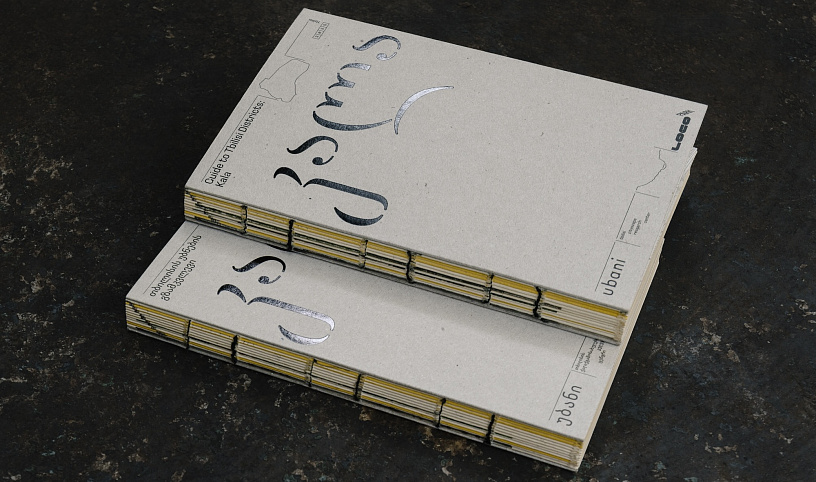
Ezologia — Porous Body of Tbilisi
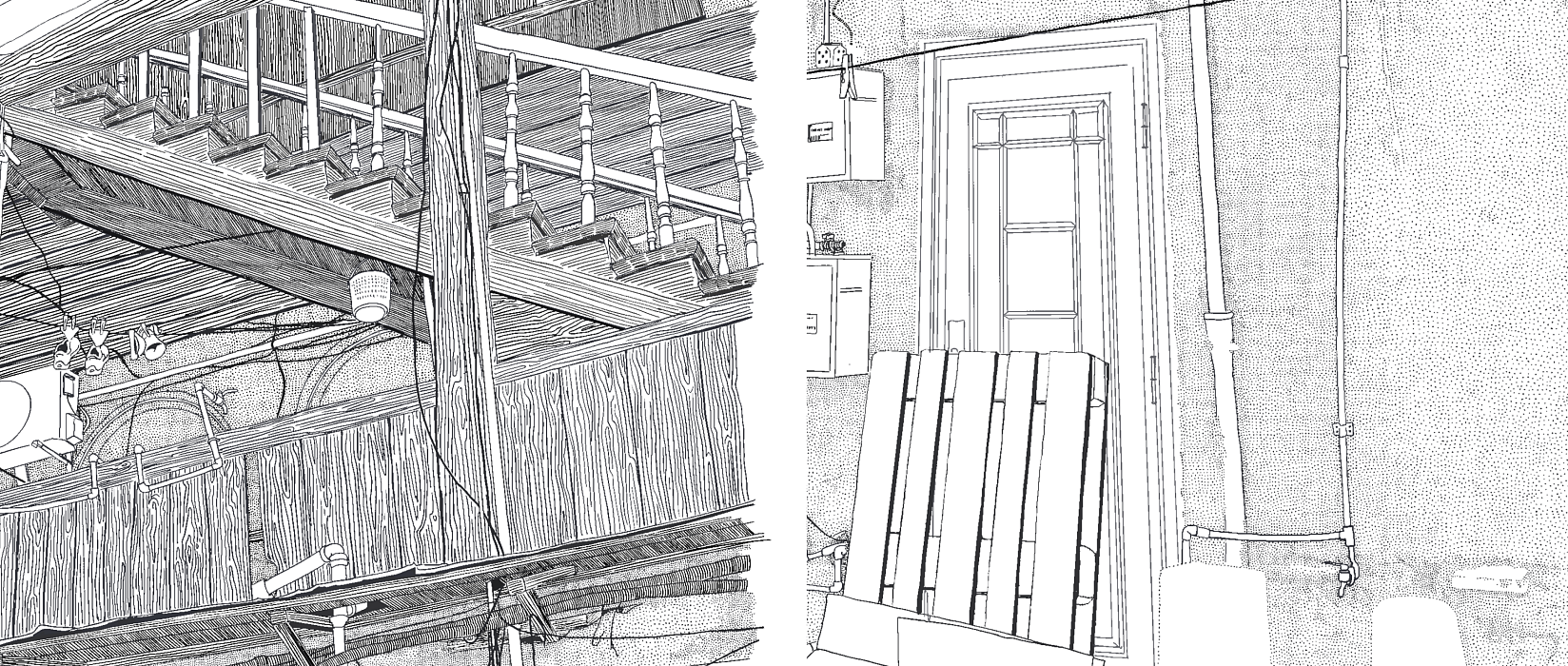
The exhibition presents the first phase of an interdisciplinary research project on Tbilisian Courtyard initiated by NWDS and Ubani — Tbilisi Cityscape Research Center.
The research was developed with wit[h]nessing, studio2AM, art historian Tatia Gvineria, architect Natalia Vasadze, sociologist Mariam Jibuti, and other independent researchers working across urban history, heritage preservation, mapping, and urban analysis. The project also included contributions from young professionals who took part in the fieldwork mapping.
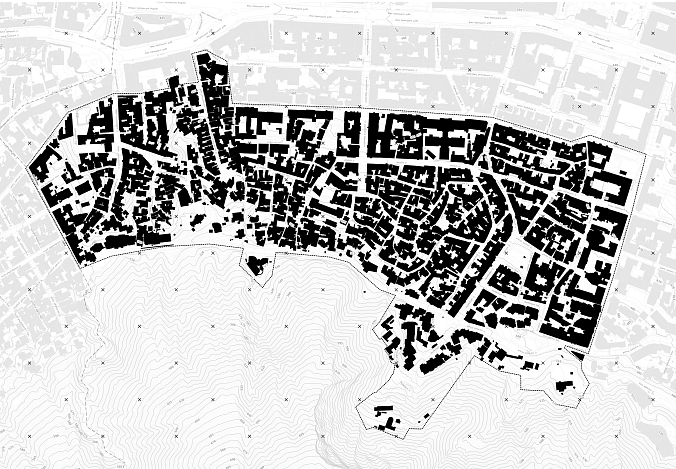
The exhibition features analytical maps, architectural research, graphic studies, archival documents, and video materials exploring the role of the typology of Tbilisian Courtyard in shaping the city’s urban fabric.
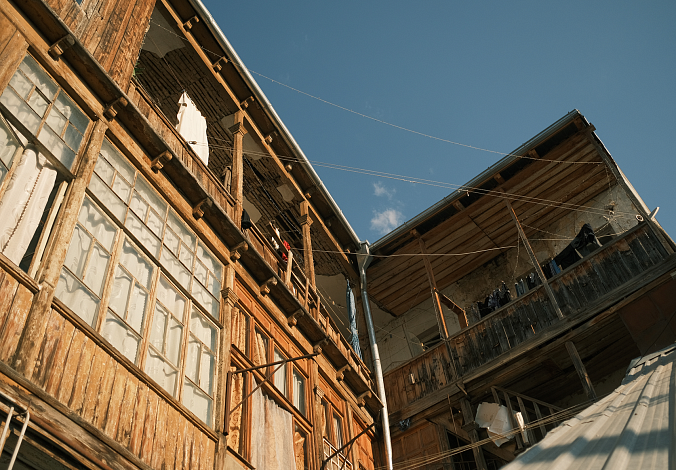
Photo essays by Berika Beridze, Nanka Dolidze and Gio Sumbadze were created specifically for the exhibition in spring 2026.
The exhibition also includes materials held in the funds of the Tbilisi History Museum, as well as videos produced by the students under the guidance of O’Brien Van der Steen Architecture Studio in 2018.
Exhibition details
Curatorial essay
Ezo (ეზო) means courtyard. But the Tbilisian Ezo (sometimes referred to as an “Italian”¹) is a shared intermediate space found in historic Tbilisi, connecting several adjoining households into a single environment of everyday life.
POROSITY
Porosity² is the capacity of urban fabric to let life pass through it — movement, gaze, nature, human interaction. In a porous city, the boundaries between inside and outside, private and collective, building and landscape remain permeable. Porosity is defined not by the number of empty spaces, but by the nature of connections between them.
This exhibition is a public presentation of the first phase of an ongoing research project — one that our studio and a growing group of collaborators have been developing.
At the centre of this research is the traditional fabric of Tbilisi’s old neighbourhoods — not as a monument, but as a living system, a way of inhabiting space. The urban fabric that has shaped the Tbilisi we know and love, yet one that is gradually disappearing.Steadily. Relentlessly. Korpusi³ after korpusi, parcel by parcel, a different city grows in place of this one. Each new volume bears little morphological relationship to what stood before it. What fades is not only the houses — it is a particular way of organising space: a balance between built and unbuilt, private and collective; between people, city, and landscape.
The existing heritage preservation framework is indeed capable of recognising the value of individual buildings. However, it is far less equipped to protect the value of urban fabric itself — of typology, morphology, spatial relationships. We are used to preserving objects made of stone and timber. But can the form of a void be preserved? A system of courtyards? A particular set of relationships between spaces?
We do not advocate for the conservation of entire city districts, nor do we believe this would be possible. We understand the forces that drive these transformations: market dynamics, development pressures, and residents’ aspirations for better living conditions. We do not see increasing density as a problem in itself. Urban densification is a natural part of a city’s development. The question is how it takes place. Is it possible to increase density without the replacement of existing urban fabric? To develop the city while retaining at least some of the spatial qualities that make it what it is?
Before these questions can be answered, we need to make this fabric visible as a subject of attention in its own right. This is why we began studying this typology from multiple perspectives: through artistic observation, historical inquiry, architectural analysis, and fieldwork mapping.
The Tbilisian Ezo is significant not only in terms of local heritage typology. It represents a unique hybrid of different cultures, bringing together the Eastern courtyard and characteristics of its lifestyle, the Western urban logic of street-facing architecture, and a distinctly Georgian sensitivity to landscape and terrain. The result is a rare form of urban fabric — one that combines the interiority of the courtyard with a high degree of spatial permeability.
All of this makes Ezo not only an object of preservation, but a source of knowledge as well. Many cities today are consciously trying to cultivate qualities that in Tbilisi emerged organically over centuries: human-scale density, environmental responsiveness, and a subtle gradation between private, shared, and public spaces. Perhaps this is why studying these spaces matters not only for understanding Tbilisi’s past, but also for caring for the cities of the future.
²The concept of urban porosity most often traced back to Walter Benjamin and Asja Lācis and their essay “Naples” (1925) — a portrait of the city’s architecture and street life that gave the term its first theoretical grounding. It is a curious coincidence that the same city whose spirit is echoed in the nickname “Italian courtyard” also inspired the concept through which we read Tbilisi’s urban fabric today.
³Korpusi (Georgian: კორპუსი) — the prevalent form of contemporary residential development in Tbilisi: a freestanding multi-storey concrete apartment block, typically without shared outdoor space or spatial connection to the surrounding urban fabric.
Project initiators
Ubani — Tbilisi Cityscape Research Center (David Brodsky, Ana Chorgolashvili, Nata Tatunashvili, Mariam Gabritchidze, Lia Gulbani, Nino Kevlishvili)
NWDS (Nata Tatunashvili, Aleksandre Gaprindashvili, Natia Katamadze, Olga Vakhrameeva, Ana Petriashvili, Julia Pliasunova, Alexander Kachalov, Salome Gabashvili)
Project collaborators
studio2AM (Annamaria Chelidze, Megi Davitidze)
wit[h]nessing (Tatuli Japoshvili, Tina Jelia, Giga Tsikarishvili)
Tatia Gvineria
Exhibition curatorial team
Ana Chorgolashvili (Archive and Research)
Natia Katamadze
Nata Tatunashvili
Exhibition design
Nata Tatunashvili, Olga Vakhrameeva (Varm)
Display table – David Brodsky
Authors of the texts
Ana Chorgolashvili, Tatia Gvineria, Mariam Jibuti, Anano Simonia, Nata Tatunashvili, Natalia Vasadze
Exhibition participants
Nina Akhobadze, Berika Beridze, David Brodsky, Annamaria Chelidze, Megi Davitidze, Nanka Dolidze, Aleksandre Gaprindashvili, Tatia Gvineria, Tatuli Japoshvili, Tina Jelia, Ana Petriashvili, Sasha Sokolova, Gio Sumbadze, Giga Tsikarishvili, Olga Vakhrameeva (Varm), Natalia Vasadze
Workshop supervisors
Aleksandre Gaprindashvili, Ana Petriashvili
Workshop participants
Mariam Dzvelaia (Student at Georgian Technical University), Teona Kakhidze (Student at Free University of Tbilisi), Davit Kuraziani (College “10x” / Graduate of Georgian University), Salome Labuchidze (Student at Ilia State University), Lile Liparteliani (Student at Free University of Tbilisi), Anastasiia Margiti (Student at East European University), Tatia Tsikhelashvili (Graduate of Apollon Kutateladze Tbilisi State Academy of Art)
Archive – Tbilisi History Museum
Barbare (Varvara) Bebutova-Gabunia (1891-1971)
David Gvelesiani (1890–1949)
David Kakabadze (1889-1952)
Dimitri Kvirikashvili (1893–1962)
Nikoloz Nordman-Severov (1887-1957)
Vladimer Tsagareli (1894-1984)
Konstantin Zanis (1864-1947)
Translation
Elene Kobidze
Language and style editing
Lera Choobara, Elene Kobidze, Tea Tvalavadze
Exhibition technical team
Video editing – Nika Saralashvili
Exhibition set-up – Aleksandr Aleksandrov, Zurab Mikaberidze
Board layouts – Yury Goriakin
Exhibition host and partner
Georgian National Museum, Tbilisi History Museum
Supported by
Tbilisi City Hall, Château Mukhrani
Media partner
homeis.ge
Special thanks to the National Archives of Georgia, Levan Kalandarishvili, Tsiko Jankarashvili, and O’Brien Van der Steen architecture studio.